 By Terre d'Ecologis
Aleppo soap is considered one of the oldest soaps in the world. It takes its name from the Syrian city where it was born and where it is still made in the same way: a slow cooking of olive oil, the addition of laurel berry oil, then months of drying in the air. Here are the steps, as they are still practised in traditional soap factories.
Four ingredients, not one more
The INCI list of a traditional Aleppo soap fits on one line: Sodium Olivate, Aqua, Sodium Laurus Nobilate, Sodium Hydroxide. In plain terms: olive oil, water, laurel berry oil and soda. Sodium Olivate and Sodium Laurus Nobilate refer to the two oils once they have been turned into soap: this is saponification. The soda appears in the list because it is used for this transformation, during cooking.
Step 1: cooking in the cauldron
The olive oil is poured into a large stone or steel cauldron, with water and soda, and heated for several days. The master soap maker watches over the paste, stirs it, and adjusts the heat. It is during this cooking that the oil becomes soap.
Step 2: salting out and washing
At the end of cooking, the paste is salted. The salt separates the soap from the cooking water, which carries away the impurities and any excess soda. This water is removed and the paste is washed. It is this step that gives Aleppo soap its purity and its long shelf life.
Step 3: laurel oil
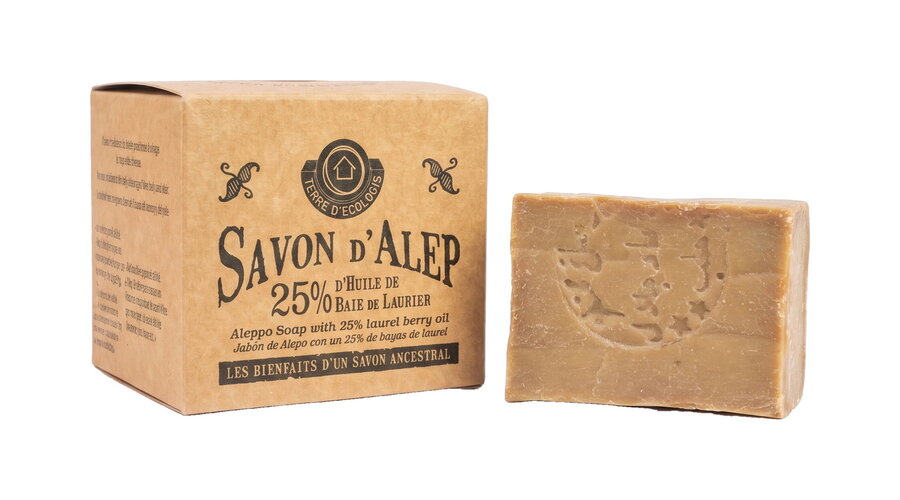
The laurel berry oil is added at the end of cooking. Its proportion makes the difference between soaps: the percentage shown on the label, 5%, 25% or 40%, is the share of laurel oil in the oil blend. The higher it is, the more present the scent of laurel.
Step 4: pouring onto the floor
The still-hot paste is poured onto the floor of the soap factory, covered with paper, where it spreads into a large green slab a few centimetres thick. The next day, once the paste has set, the workers cut it into cubes using a blade rake, walking on it with boards attached to their feet. Each cube then receives the soap factory's stamp, struck by hand.
Step 5: drying in towers
The cubes are stacked in open towers, to let the air through, and dried for several months, often nine months or more. As it dries, the surface of the soap browns on contact with the air, while the inside stays green: this is the signature of Aleppo soap, which you find when you cut a bar in two. The soap also loses water and hardens, which makes it last longer in the bathroom.
How to recognise a traditional Aleppo soap
- An ingredient list of four names, with no added fragrance, no colouring, no preservative
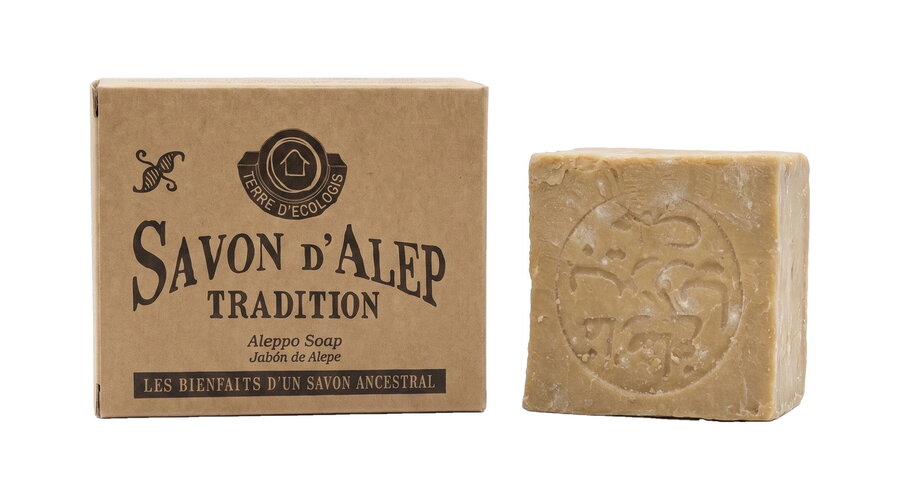
- A cube that is brown on the outside, green on the inside, with a stamp in relief
- A light soap, which often floats in water when it is properly dry
- A laurel percentage clearly displayed
A good-quality Aleppo soap can also be recognised by its smell: good-quality olive oil gives a lighter soap and a pleasant scent, whereas cheap soaps made from pomace oil, the residue of the olive after pressing, are darker and smell stronger.
Our Aleppo soaps
Our Aleppo soaps are made in Aleppo, Syria, according to this process. The Tradition Aleppo soap and its unpackaged, loose version, the 5% laurel, the 25% laurel and the 40% laurel. The same soap is available as liquid Aleppo soap and as laundry flakes. See the whole range.